A new website. A new business name. A switch to different suppliers, or a parent company that wants everyone on one global site. These are normal, often sensible business decisions.
But there’s a cost that rarely shows up in the plan: the search visibility you’ve already built. It’s the people who search for your name, the pages that already rank on Google, and the customers who recognise you when you appear. You don’t pay for it each month, so it’s easy to forget it’s there until it’s gone.
That’s why we start any big change with a simple website migration checklist: count what you have before you change anything.
In short
- Your existing search visibility is a business asset, even though it never shows up on an invoice.
- Local customers can search very differently from customers overseas.
- If visibility drops, paid ads have to fill the gap, and that costs more every month.
- Count it before the change, so you can plan and budget for the gap.
Why it matters: the asset you don’t pay for
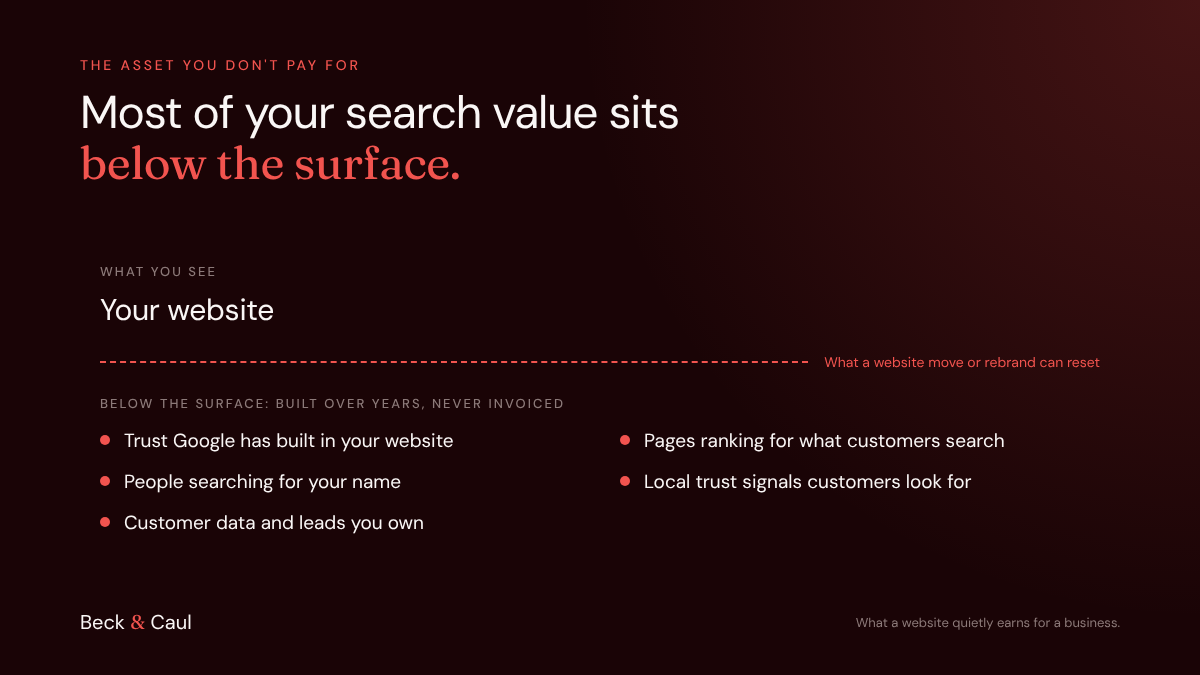
Most of a business’s marketing has a price tag: ad spend, design, printing. Search visibility built up over years doesn’t. Google has learnt to trust your website. Your pages rank for the things customers search for. People type your name because they already know you.
A website move or a rebrand can reset some or all of that. When it does, enquiries rarely drop overnight. They fade over weeks or months, and by the time someone notices, it’s hard to trace back to the change.
We’ve worked with two businesses on opposite sides of this problem.
Scenario 1: an overseas head office wants one global website
A New Zealand manufacturing business is part of an international brand with its head office in the UK. Head office planned to replace the local New Zealand website with a section of one standard global site.
One website for every country is tidier on paper. Our job was to work out what it would mean for the New Zealand business, using evidence rather than opinion. We asked four questions.
Do New Zealanders search the same way UK customers do?
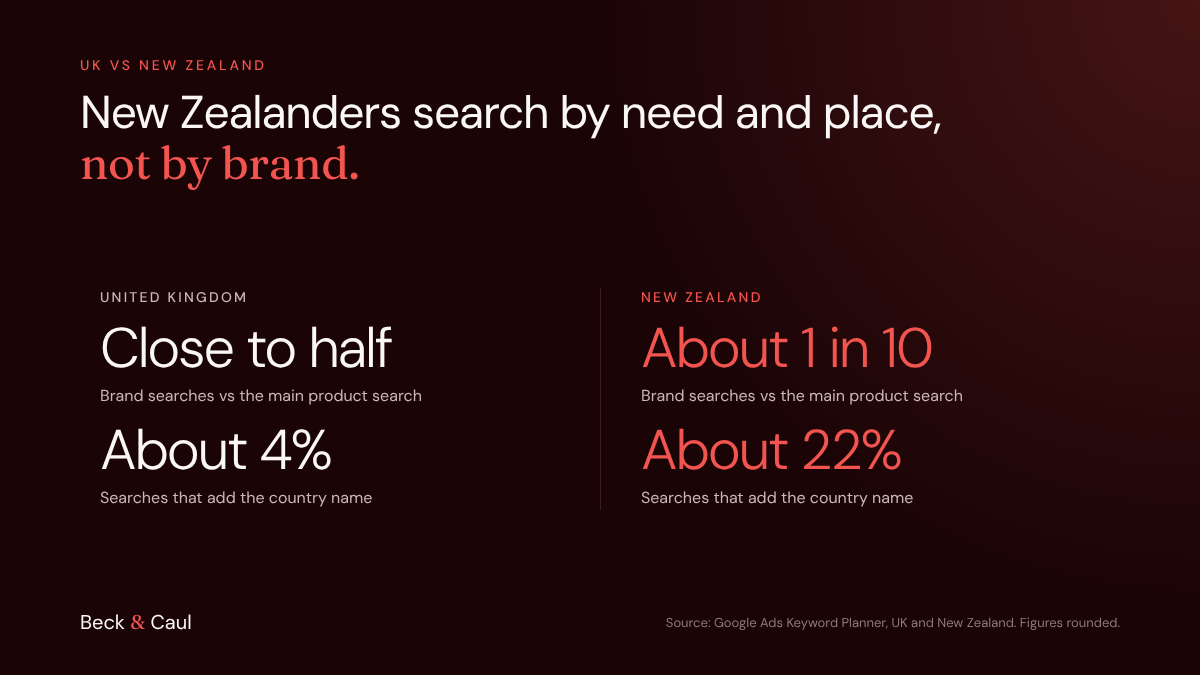
No. In the UK, the brand is well known: searches for the brand name were close to half as common as the main search for the product. In New Zealand, brand searches were closer to one in ten. Most New Zealand customers find the business by searching for what they need, not who it’s from.
How local are New Zealand searches?
Very. New Zealanders were about five times more likely than UK searchers to add the country to their search (“… NZ”). Searches that included a city, like Christchurch or Auckland, were far more common here than for comparable UK cities, despite the difference in population. Kiwis want to buy from someone nearby.
To test this, we took the main product search term and added a city name to it, the way a customer would type it: the product followed by “Christchurch”, “Auckland”, “London”, “Manchester” and so on. Then we compared how often each city version was searched in a typical month, using Google Ads Keyword Planner.
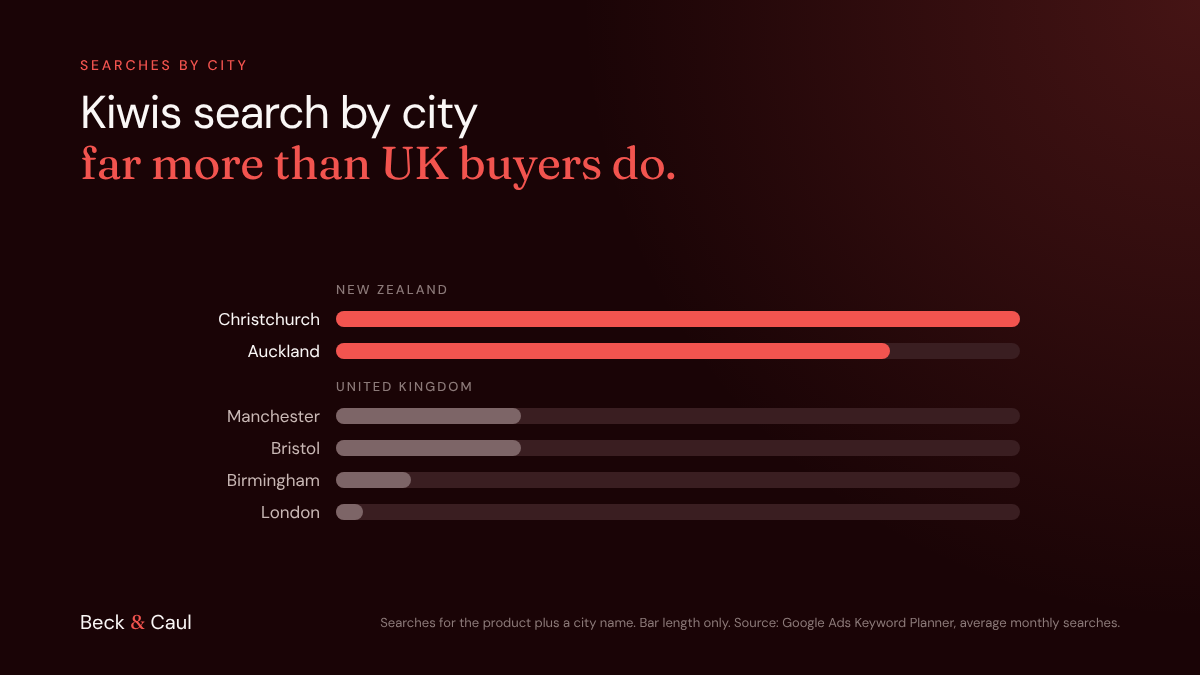
Even London, many times the size of Christchurch, draws only a fraction of the city-based searches. New Zealand buyers want to know who’s near them.
Put together, the two markets look like this:
| United Kingdom | New Zealand | |
|---|---|---|
| How buyers find the business | Often by brand name | Mostly by what they need |
| Country name in the search | Rarely | Often (“… NZ”) |
| City name in the search | Uncommon | Common |
| What a global website risks | Little: the brand does the work | Local visibility and trust |
What is the current website actually earning?
The existing New Zealand website ranked on the first page of Google for the brand and for key general searches. The proposed new address had no search history in New Zealand at all. A new address starts from zero, however good the global site is.
If visibility drops, what replaces it?
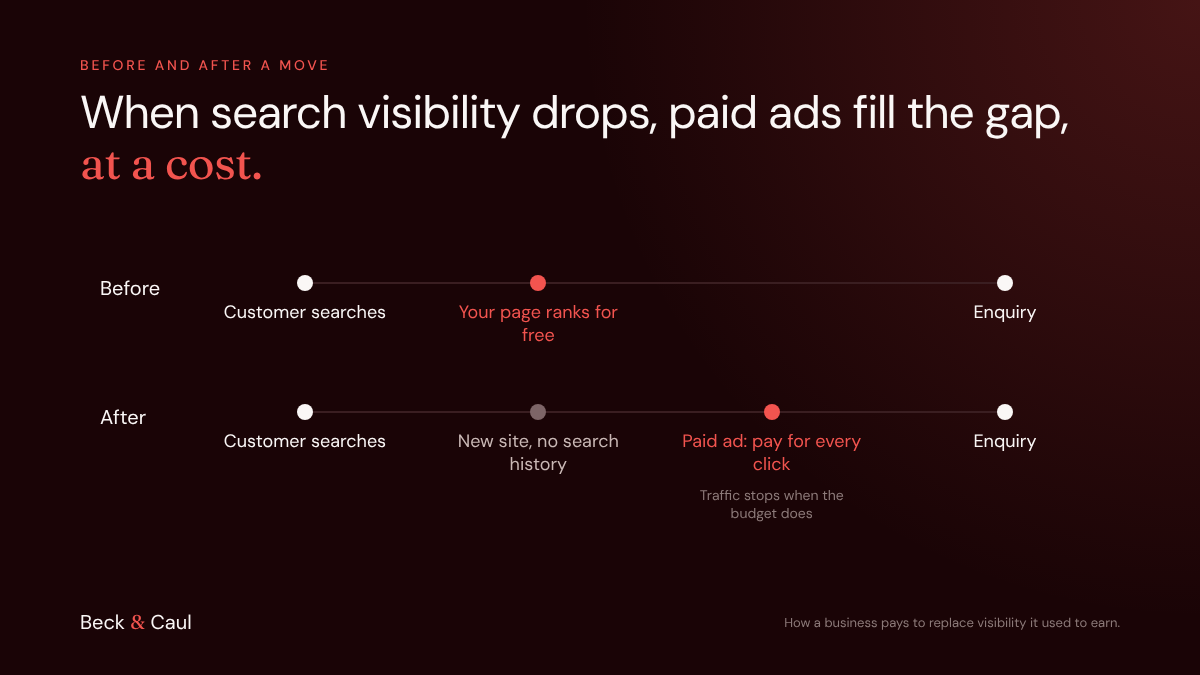
Paid advertising. That means paying every month for clicks the business currently gets for free, with traffic that stops the moment the budget does. In a market where brand searches are already weak, leaning on paid ads is both more expensive and less stable.
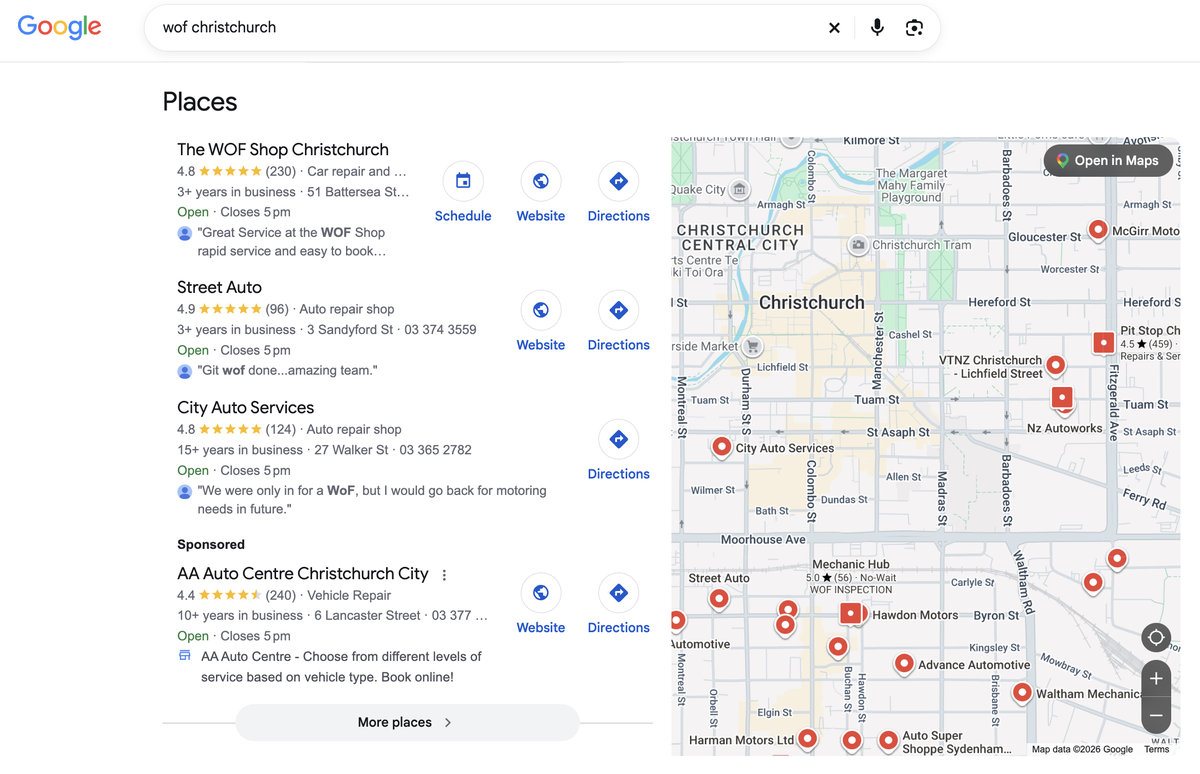
We also looked at how people buy. This is a considered, practical purchase. Buyers want to see local dealers, servicing and delivery information. A one-size global site risks pushing those local trust signals into the background, even if traffic holds up.
Scenario 2: building a name after leaving well-known brands
The second business had already made its change. A home services company working across Auckland and Christchurch had stopped selling two of the best-known supplier brands in its category, and now traded under its own name.
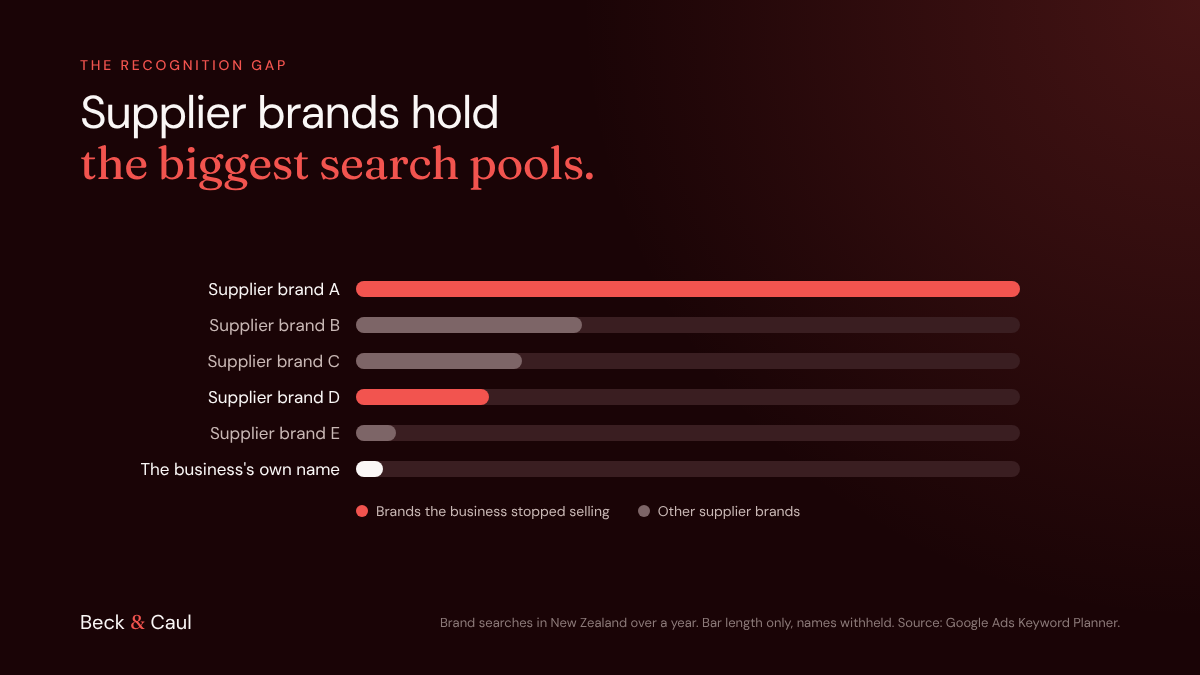
That was a sound commercial decision. But those supplier brands carried most of the brand searches in the market. When customers search for a product by brand, they find the businesses that sell that brand. Stepping away from them meant stepping away from the biggest pools of people already searching.
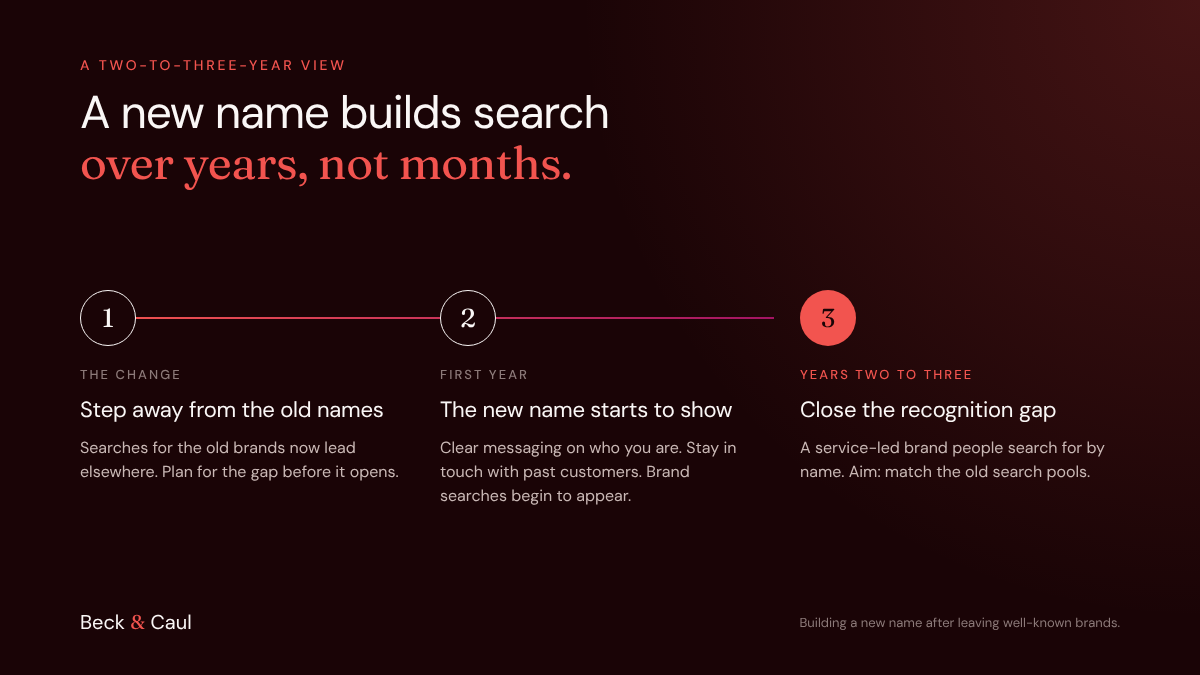
We compared brand search demand in New Zealand, Auckland and Christchurch: the business’s own name against the established brands it now competed with. The good news was that its own name was already appearing in brand searches within a year, so it was starting to fill the gap.
We were also honest about the timeline. Building brand search for a new name takes years, not months. Until then, the business needs to work harder to be found: clear messaging about who it is, staying in touch with past customers, and building a service-led brand people search for by name.
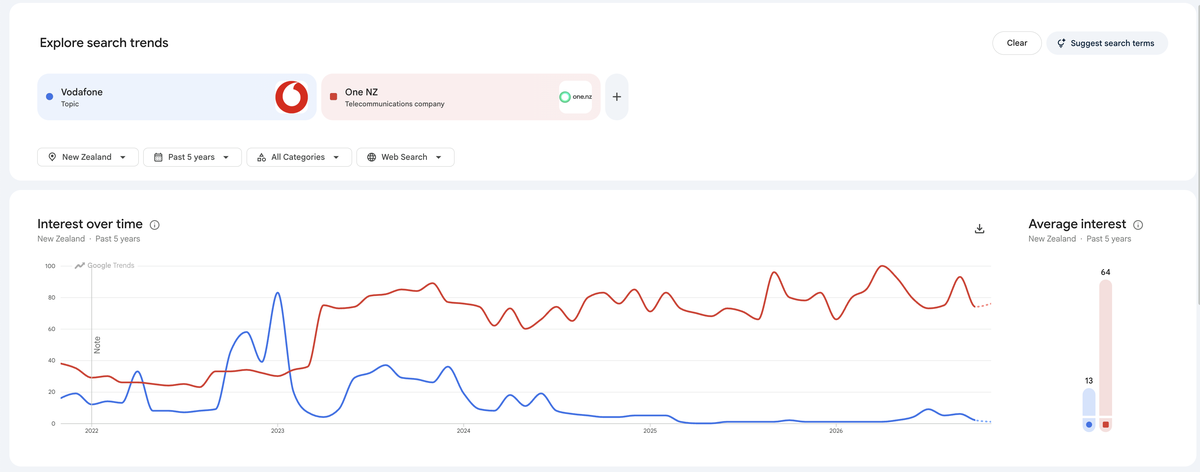
Two well-known New Zealand rebrands show how long an old name lingers, even with national advertising behind the change.
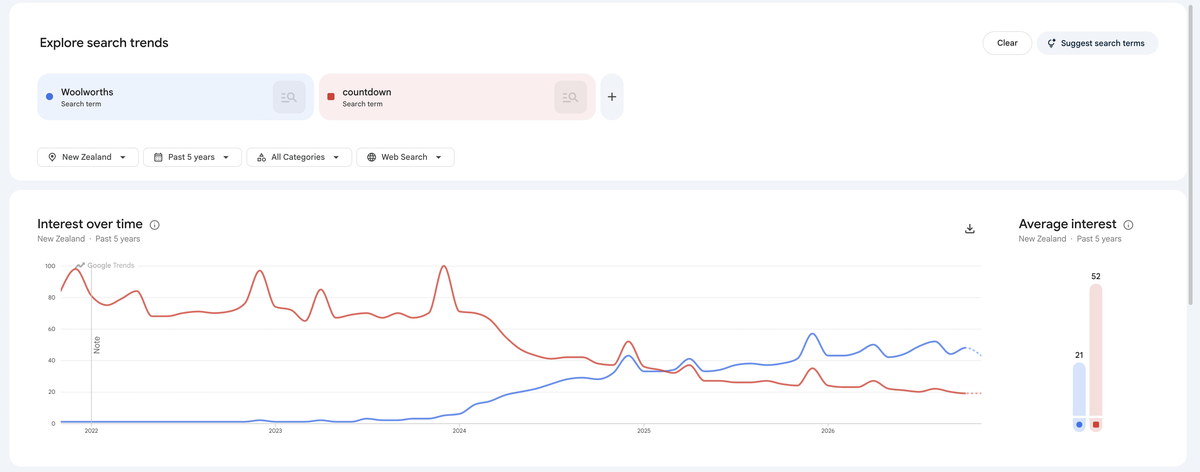
If names this big take years to settle, a smaller business should plan for at least the same.
What we recommended: the ideal, and the realistic
For the manufacturing business, the ideal outcomes were clear, and we said so: keep the New Zealand website, or keep real local control inside the global one.
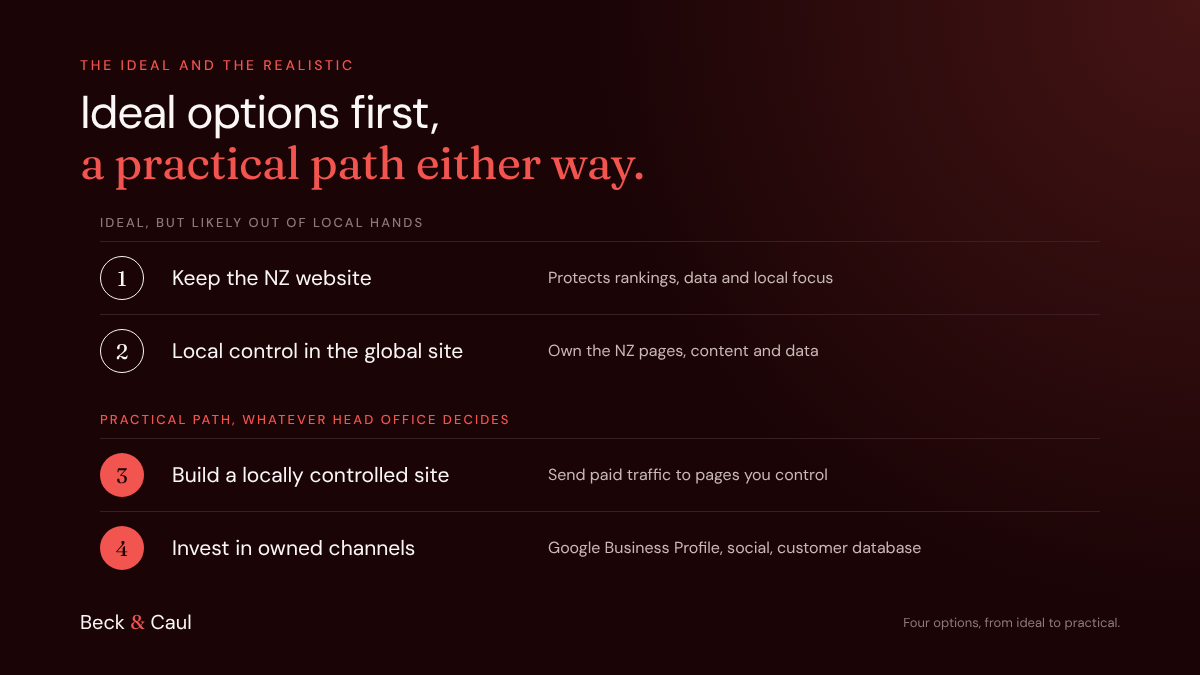
We were also realistic. Head office decisions aren’t always open to negotiation. So we laid out a practical path that protects the New Zealand business either way:
- Keep the New Zealand website. The ideal, but likely out of local hands.
- Secure local control within the global site. Ownership of New Zealand content, pages and performance data.
- Build up a locally controlled website. Strong product pages, with paid ads sending traffic there, so the business keeps its leads and data.
- Invest in channels the business owns outright. Google Business Profile, social media and the customer database, so it relies less on any one website.
We also suggested one question to put to head office before the change goes ahead: if the global site takes over, who will fund and manage New Zealand advertising to fill the gap?
For the home services business, the recommendation was about patience and focus. Build the new name steadily with clear, confident messaging, keep past customers close, and set expectations that brand searches grow over two to three years, not one.
Your website migration checklist
Before a rebrand, a new website or a supplier change, answer these questions. Most take minutes with Google Search Console and Google Ads Keyword Planner.
- How many people search for your name? And for any brands you carry that you might stop selling?
- Which pages bring in the most visits and enquiries? Will they still exist, at the same address, afterwards?
- Which searches do you rank on the first page for? Note them now, so you can compare later.
- Will old page addresses redirect to the new ones? One redirect per page, not everything to the homepage.
- Who will own the website, the data and the customer relationship afterwards?
- Do local customers search differently? City names, country names, local wording.
- If visibility drops for six to twelve months, what’s the plan and the budget to cover it?
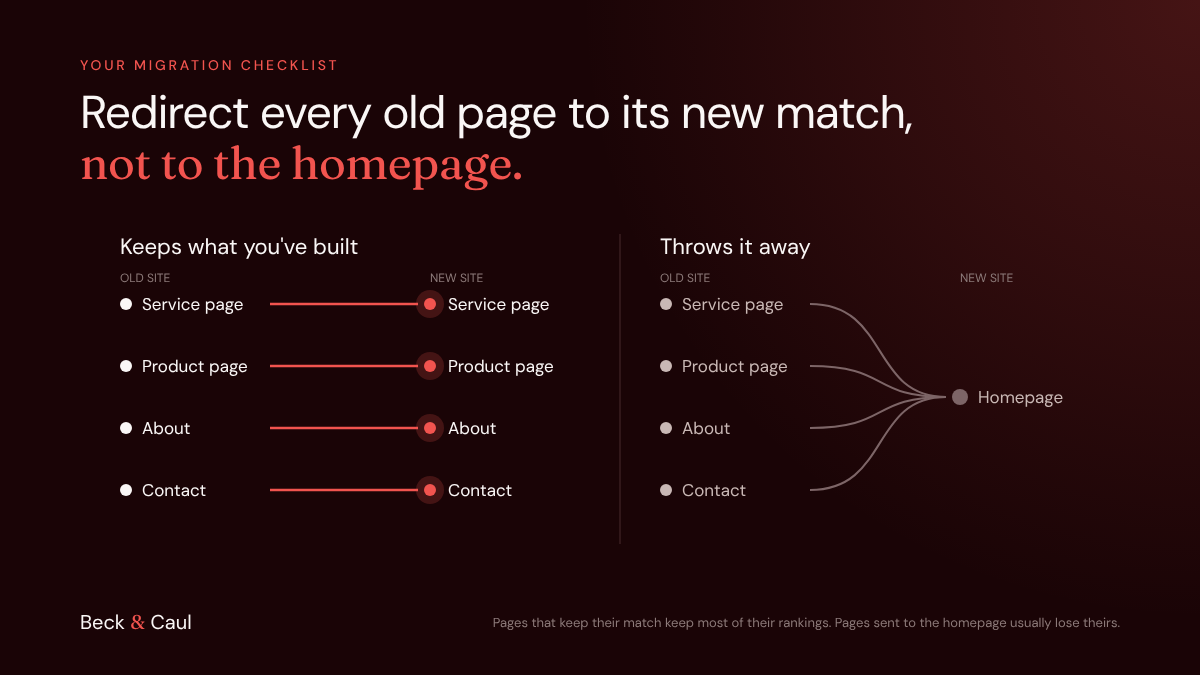
If you can’t answer one of these, that’s the place to start.
What to count, and where to find it
| What to count | Where to find it | Why it matters |
|---|---|---|
| Searches for your name | Google Ads Keyword Planner | Shows how much demand is tied to your name |
| Searches for brands you sell | Google Ads Keyword Planner | Shows what you lose if you stop selling them |
| Your top pages by visits and enquiries | Google Analytics | These pages must survive the move |
| Searches you rank on page one for | Google Search Console | Your baseline to compare after the change |
| Local searches (city or country added) | Keyword Planner, Google Trends | Shows how much local pages matter |
| Reviews and local listings | Google Business Profile | Local trust that should carry over |
Count first, then change
We’re a Christchurch agency working with businesses across New Zealand, many of them going through just this kind of change. Before anything moves, we make sure you know what you have, what you could lose and what it would take to cover it. If you’re planning a new website or a new name, talk to us about your website.
FAQ
Will a new website affect my Google rankings? It can. Google needs to re-learn a new site, especially if page addresses change or content is cut. Rankings often dip for a period after a move. Good redirects, keeping your strongest pages and checking Search Console closely all help limit the drop.
Does rebranding hurt SEO? A new name doesn’t hurt your website by itself, but people stop searching for the old name, and it takes time for them to search for the new one. Plan for that gap, and keep the old name visible for a while (“formerly known as”) so returning customers can still find you.
What should a website migration checklist include? At minimum: your current brand search volume, your top pages and first-page rankings, a redirect plan for every old address, who owns the data afterwards, and a budget to cover any temporary drop in visibility.