You stock dozens of brands. Some sell steadily, some get lots of attention but few sales, and some seem to sell only alongside something else. Which ones deserve the ad budget, the homepage space and the promotions?
Most online stores answer that with gut feel, or by pushing whatever is newest. But the answer is usually already sitting in the store’s own data. Ecommerce conversion rate optimisation doesn’t have to start with a redesign. It can start with four questions about how customers already behave.
In short
- Find the products that turn browsers into buyers, and the ones that earn the most per visitor.
- Read your site search: it’s customers telling you what they want, in their own words.
- Look at what’s bought together, and whether it’s planned or accidental.
- Give each brand a clear job: win new customers, build loyalty, or lift the basket.
The business: many brands, one question
A New Zealand online homewares store carries a wide range of imported brands, from everyday kitchen items to gifts and seasonal pieces. The owners wanted to know where to focus their marketing.
The store already had more than a year of website analytics. That’s where we started, with no new tools and no new tracking.
Question 1: which brands turn browsers into buyers?
We plotted every brand by how often its products were viewed against how often they were bought.
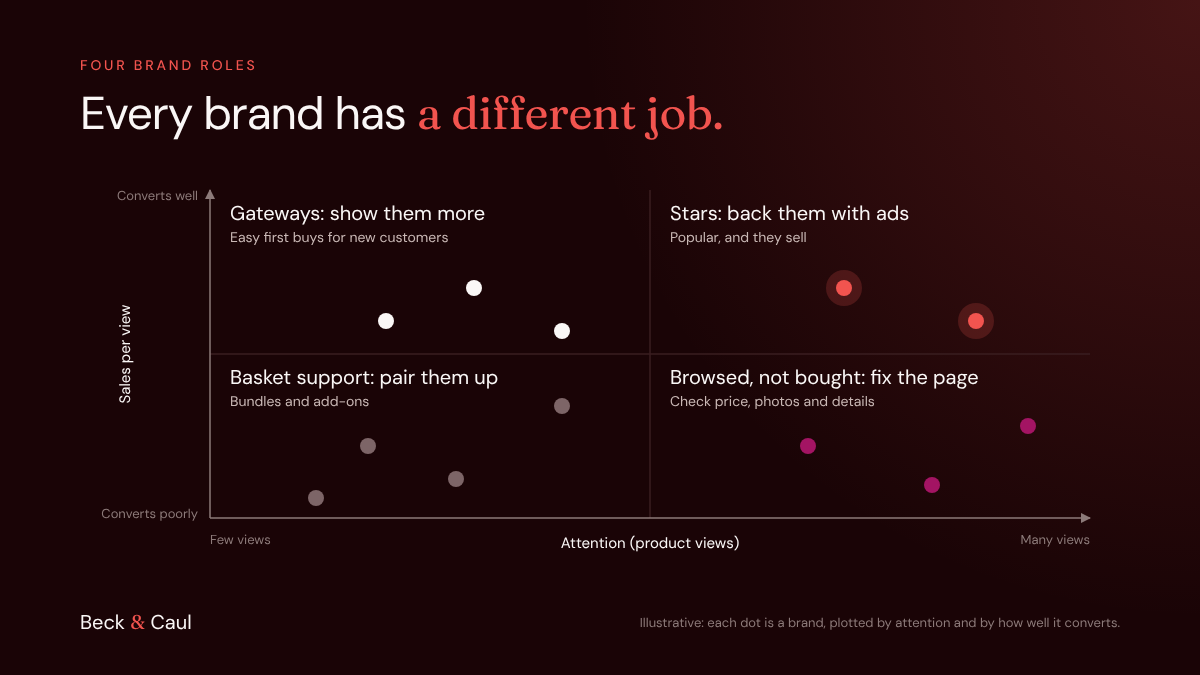
Some brands were viewed heavily but bought less often: people liked looking, but something held them back. Others were bought at a much higher rate for the attention they got. We called these gateway brands. They’re a natural first purchase for new customers, because buying from them comes easily.
Question 2: which brands earn the most from each visitor?
Conversion rate isn’t the whole story. A cheap item can sell often and still add little revenue. So we also compared views against revenue.
One brand stood out for revenue per view: every visitor who looked at it was worth more to the business than for any other brand. That makes it a strong candidate for paid ads and featured collections, because the spend is more likely to pay back.
Put the two questions together and every brand falls into one of four roles.
Question 3: what are visitors searching for on your site?
The search box on an online store is one of the most underused sources of insight. It shows exactly what people came looking for, in their own words, and they’re already on your site.
We grouped the store’s internal search terms into themes. Three stood out alongside everyday product searches: specific brands, seasonal items and home interior pieces.
| Search theme | Examples of what people typed | What to do with it |
|---|---|---|
| Specific brands | Brand names, often the same few, again and again | Give those brands their own collection pages and menu links |
| Seasonal | “christmas”, “easter”, “hot water bottle” | Launch seasonal collections early and feature them on the homepage |
| Home interior | “cushion”, “throw”, “rug”, “candle”, “vase” | Group these into an easy-to-find interior category |
| Everyday products | “desk”, “shelf”, “storage” | Make sure the top results show the right products, in stock |
If people are repeatedly searching for something, it should be easy to find in the menu, not buried three clicks deep. Every search that ends in “no results” or the wrong product is a sale at risk.
Question 4: which brands are bought together?
Finally, we looked at orders. Was each customer buying from one brand, or mixing several?
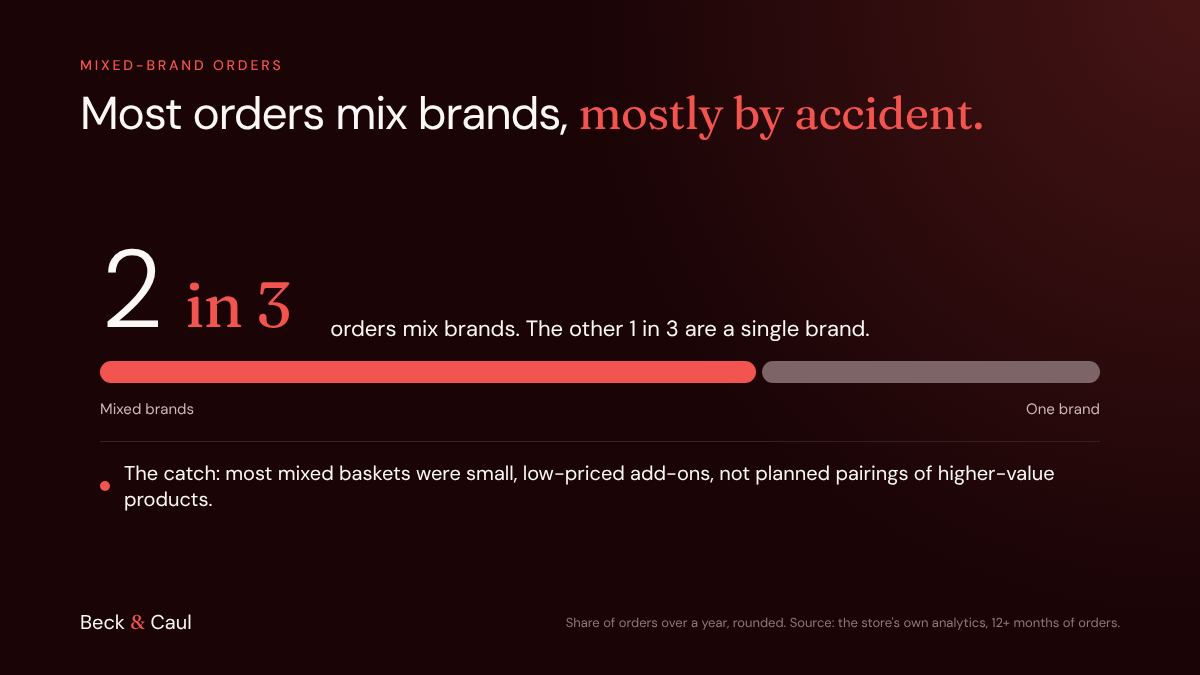
About two in every three orders included more than one brand. That’s a good sign: customers are happy to discover new things. But most of the mixing was accidental. Shoppers were adding small, low-priced items to their basket, rather than combining higher-value products.
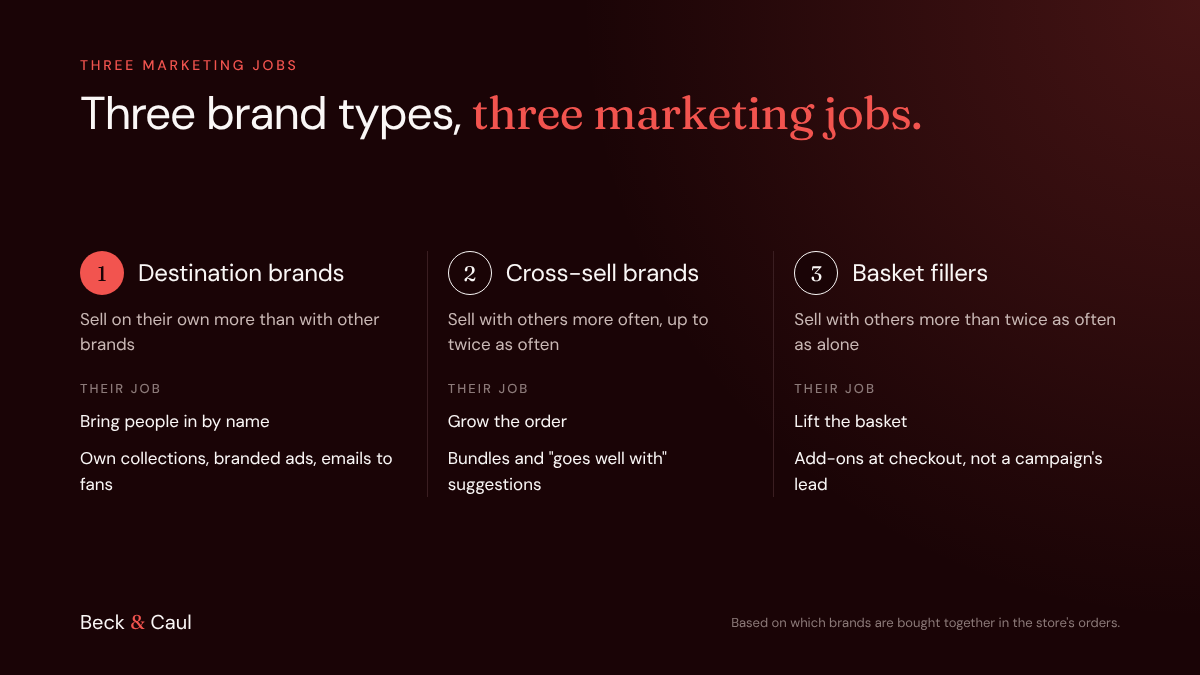
To make this useful, we sorted brands into three types based on how they’re bought. Comparing how often a brand sells on its own with how often it sells alongside others gives a simple, repeatable rule.
We also listed the brand pairs most often bought together. Some promising combinations were selling together without any help, which made them obvious candidates for deliberate bundles.
What we recommended: turning analysis into decisions
| What we found | What to do | Where it shows up |
|---|---|---|
| One brand earns the most per visitor | Put ad spend and featured spots behind it | Paid ads, homepage, featured collections |
| Gateway brands convert easily | Use them to win first-time customers | New-customer ads, welcome emails |
| Destination brands bring people in by name | Build out their collections; branded ads and emails to fans | Collection pages, branded search ads, email |
| Strong pairings happen by accident | Turn them into curated bundles | Product pages, gift sets, checkout |
| Site search shows clear themes | Make those themes easy to find | Main menu, seasonal landing pages |
| Some brands are browsed but not bought | Check price, photos and product details | Product pages |
None of this needed new tracking or expensive tools. The answers were already in the store’s data. They just needed the right questions.
Bundle pricing: four types worth testing
Bundles are the most direct way to turn accidental pairings into planned ones. Here are four common types, each with a generic example:
| Bundle type | Generic example | When it works best |
|---|---|---|
| Gift set | A throw, a candle and a mug, boxed together | Seasonal peaks like Christmas and Mother’s Day |
| “Complete the look” | A cushion cover with a matching throw | Home interior products bought for one room |
| Starter kit | Everything needed to try a product range for the first time | Winning new customers with a gateway brand |
| Mix and match | Any three items from one collection at a set price | Encouraging bigger orders without heavy discounting |
The best bundle pricing example is usually your own: look at what customers already buy together, then make it easier and a little better value to buy as a set.
Try this on your online store
- Which products get lots of views but few sales? Do you know why?
- Which brands or categories earn the most for every visitor?
- When did you last look at what people type into your site search?
- What do customers already buy together? Is any of it a bundle yet?
- Does each of your main brands have a clear job in your marketing?
Questions first, campaigns second
We’re a Christchurch agency working with businesses across New Zealand, including online retailers. Before recommending where to spend, we look at what your own data already says about your customers. If you’d like a fresh look at yours, talk to us about your digital marketing.
FAQ
What is ecommerce conversion rate optimisation? It’s improving how many online store visitors go on to buy. It covers product pages, site search, navigation, checkout and which products you promote, using your own data to decide what to fix first.
Where do I find this data? Most of it is already in Google Analytics (GA4) and your store platform, such as Shopify or WooCommerce: product views, purchases, revenue, site search terms and the items in each order.
Do bundles work for small online stores? Often, yes, especially when they’re built from products customers already buy together. Start with two or three bundles based on real orders, and check whether they lift your average order value.