
“We want to grow.” It’s one of the most common things a business owner tells us. But it can mean three very different plans: sell more to the customers you have, win new ones, or open up a new kind of customer altogether.
Each of those needs different marketing, different budgets and different people. Picking the wrong one means spending a year chasing the wrong kind of growth. And the right choice usually comes down to one number most businesses haven’t worked out: their share of the market.
This is how we do a market share analysis before recommending a growth strategy.
In short
- Count how many businesses could realistically buy from you.
- Understand the conditions your customers are in, because a flat market changes the job.
- Map your competitors by what they can and can’t do, not just by name.
- Let your market share decide which growth option leads.
The business: a B2B supplier with three options
A Christchurch wholesale and supply business sells to other businesses, from large equipment through to everyday supplies and consumables. It also has a showroom. Three directions were on the table: grow with existing customers, win more trade customers, or open the showroom up to the public.
All three were reasonable. But each assumes something different about where the business stands today. So before recommending anything, we set out to understand the market.
Step 1: how many businesses could buy from you?
The first question is simple: how many businesses in your area could realistically be customers?
For a B2B supplier, that’s very answerable. Stats NZ publishes business counts by industry and by area, so we counted the businesses in the client’s customer industries across Christchurch, split by type. Adding neighbouring districts like Selwyn and Waimakariri widened the picture for businesses that serve the wider metro area.
A worked example with public data Say your customers are cafés and restaurants. Stats NZ’s business counts tell you Canterbury has 1,269 café and restaurant locations, the second-largest market in the country after Auckland. Across all accommodation and food businesses, Christchurch City alone has 2,460. That’s your starting point: the total pool you could sell to.
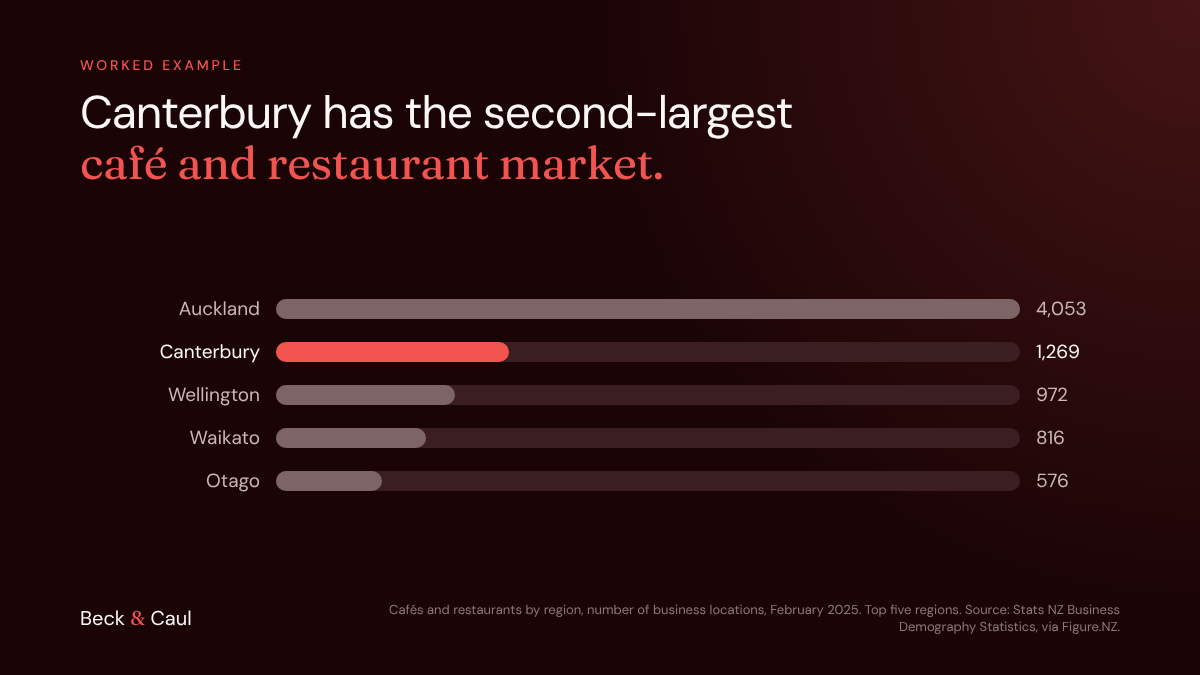
Sources: Stats NZ via Figure.NZ, cafés and restaurants by region; Stats NZ via Figure.NZ, businesses in Christchurch City. February 2025.
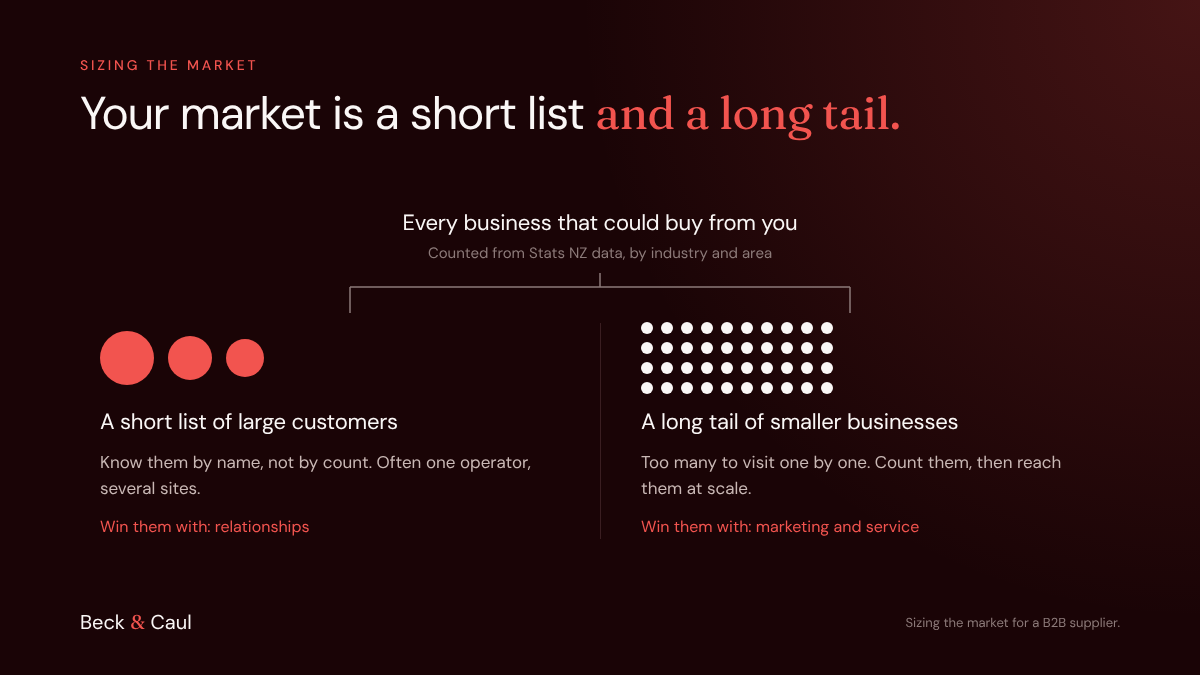
We also noticed something that changes how you market. The biggest customers aren’t a number to count. They’re a short list of named organisations, sometimes with one operator running several sites. Those need a relationship approach. The long tail of smaller businesses needs a different one.
Step 2: what conditions are your customers in?
Next we looked at the health of the customers’ own industry. Industry reporting showed record sales across New Zealand, but very little real growth, while operating costs like supplies and wages were rising faster than general inflation.
The same example, continued: the Restaurant Association’s 2025 Hospitality Report shows New Zealand hospitality sales at a record $15.99 billion, but up just 1.4% on the year before. Meanwhile, food prices rose 4.8%, well ahead of overall inflation of 2.7%. A record total with thin growth and rising costs: that’s a flat, squeezed market. Source: Restaurant Association of NZ, 2025 Hospitality Report.
For a supplier, that matters in two ways.
First, in a flat market, growth has to come from taking share rather than riding a rising tide.

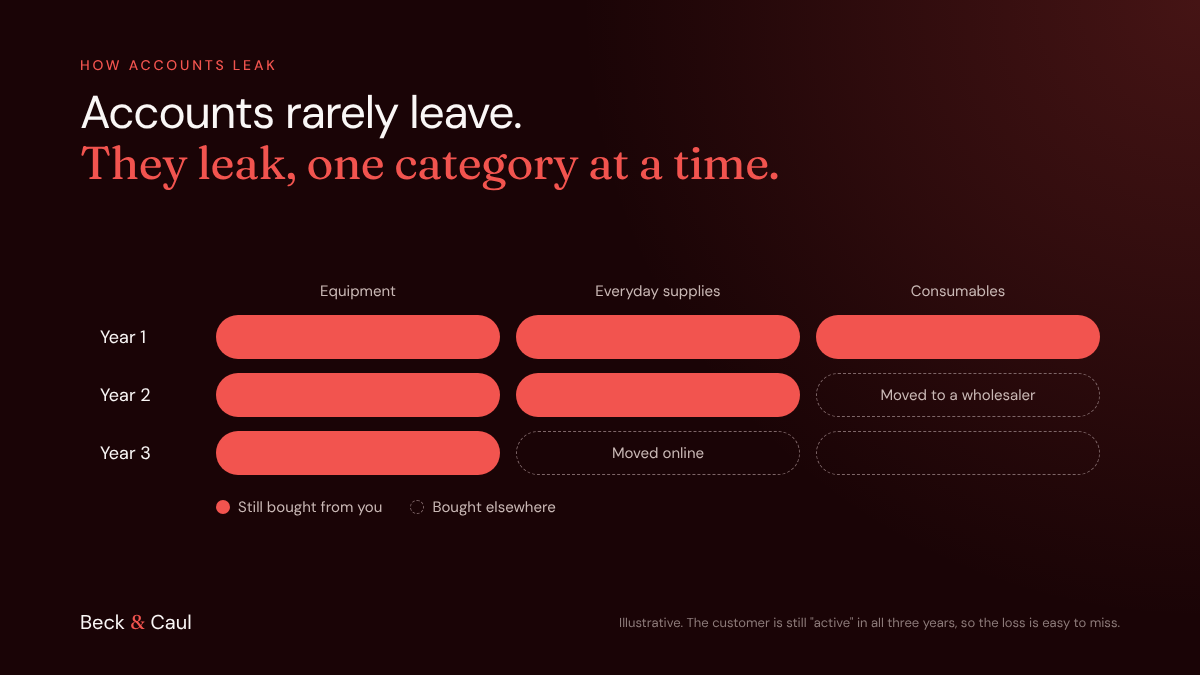
Second, squeezed customers rarely switch suppliers overnight. More often, they quietly move one category, such as consumables, to someone cheaper. Then another. Accounts leak line by line, and because the customer is still buying something, it’s easy to miss.
Step 3: competitor analysis by business model, not by name
Most competitor analysis is a list of names. That tells you who’s out there, but not where you can win. So we grouped competitors by business model instead. Each type has a real strength, and a real limit.
| Competitor type | Wide range | Low prices | Local people and advice | Can supply the whole account |
|---|---|---|---|---|
| Large national full-service supplier | ✓ | ✗ rarely cheapest | ✓ | ✓ |
| Online discounters | ✓ | ✓ | ✗ | – |
| Fit-out and project specialists | – | – | – | ✗ weak on everyday supplies |
| Small local operators | ✗ limited stock | ✓ | ✓ | – |
| Consumables wholesalers | ✗ consumables only | ✓ volume pricing | ✓ regular visits | ✗ |
| Manufacturers selling direct | ✗ one brand | ✓ on their own brand | – | ✗ |
| Big-box retailers | – | ✓ | ✗ no rep, no trade credit | ✗ |
| A local, full-range supplier with reps | ✓ | – | ✓ | ✓ |
✓ a real strength · ✗ a real limit · – not a defining feature. Strengths drawn from public filings and company websites; limits are our assessment.
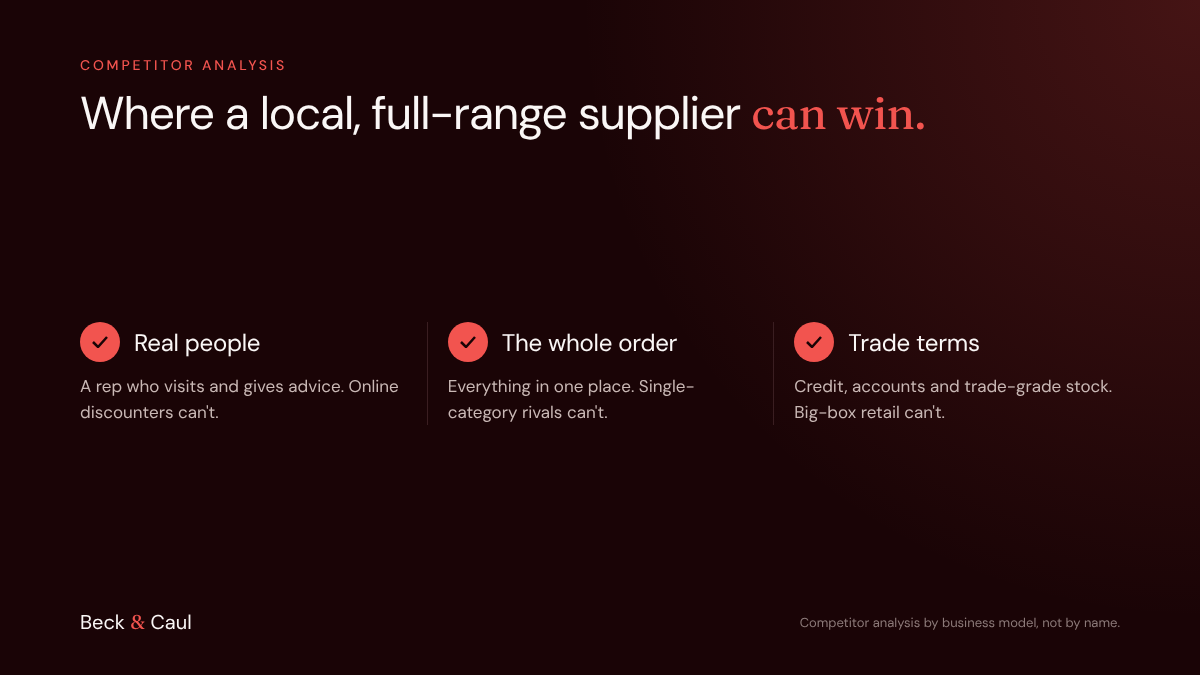
Seeing it this way shows where the client could win. A supplier with local people, regular customer contact and a full range can do things the online discounters and single-category specialists can’t. That’s worth protecting, and worth leading with in the marketing.
This is also the kind of competitive analysis that belongs in a marketing plan: not “who are they?”, but “what can we offer that each of them can’t?”
Step 4: lay out the options, and the one number that decides
We deliberately didn’t recommend a single direction yet. Instead, we laid out the three options and what each one assumes about the business.
| Option | Makes sense when… | Best targets | Watch out for |
|---|---|---|---|
| Grow with existing customers | You already reach a good share of the market | Accounts buying only some categories from you | Leakage you haven’t noticed yet |
| Win more trade customers | You reach only a small share of the market | Larger organisations with several sites, not the smallest buyers | Small accounts that cost more to serve than they earn |
| Sell to the public | There’s real foot traffic and a margin worth chasing | Shoppers wanting trade-quality products | Big-box retailers already own this space on price |
The deciding factor is one number: how many active customers the business has in Christchurch. Divide that by the number of businesses that could buy, and you have your market share. That single figure tells you which option should lead.
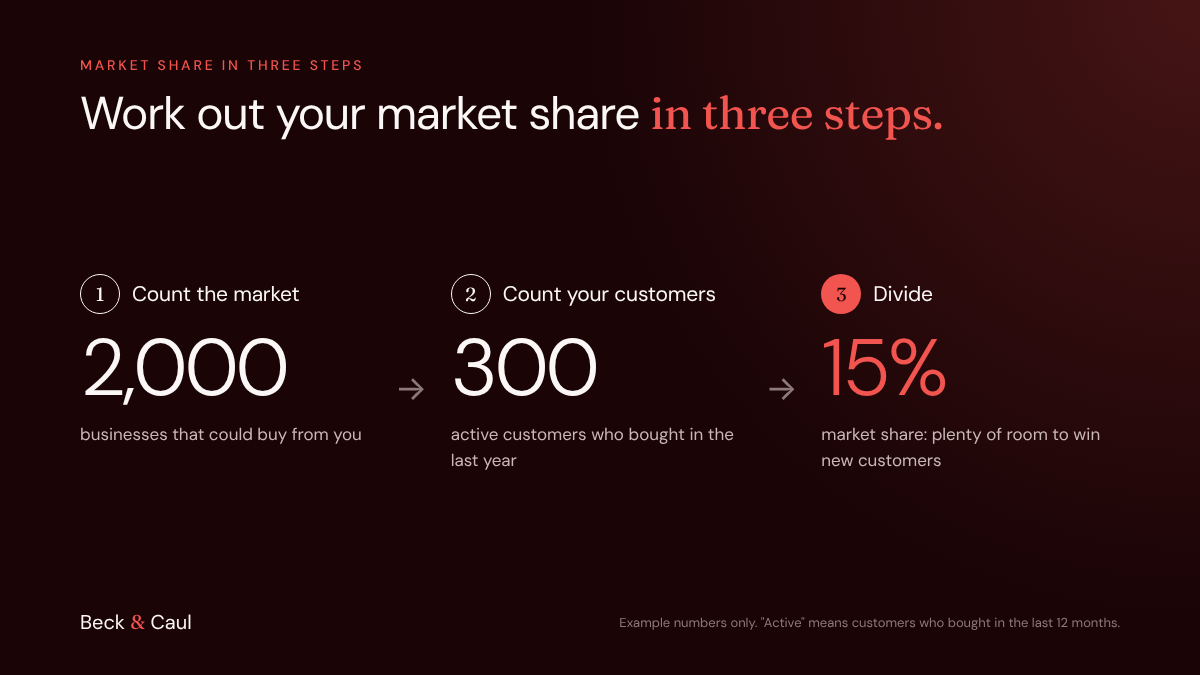
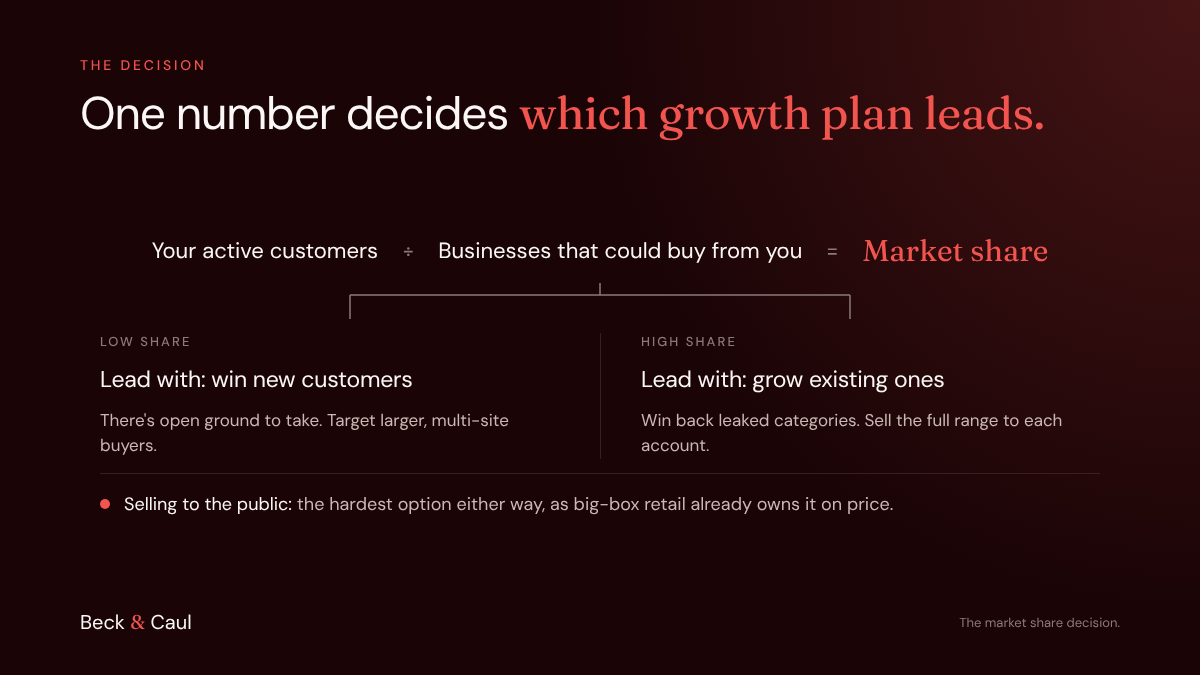
We asked the client for that number before going further. It’s the kind of figure only the business has, and it turns a list of options into a clear direction.
Why we work this way
It would have been easy to jump straight to “let’s run a campaign to win new customers”. But if the business already served most of its market, that campaign would chase a shrinking pool, and the real opportunity, selling more to the customers it already had, would go untouched.
Getting the question right first means the marketing that follows is aimed at the actual opportunity. It’s business development market research, done before the budget is spent rather than after.
Try this on your business
- How many businesses in your area could realistically buy from you? (Stats NZ business counts are a good starting point.)
- How many of them buy from you today?
- Of your existing customers, how many buy everything they could from you, and how many only some categories?
- Who are your competitors by type, and what can you offer that each type can’t?
- Which growth option does your market share point to?
Know the number, then grow
We’re a Christchurch agency working with businesses across New Zealand, many of them B2B suppliers without an in-house marketing team. Before we recommend where to grow, we help you work out where you stand. If that’s a question on your mind, talk to us about your digital marketing.
FAQ
What is a market share analysis? It’s working out what share of the possible customers in your market already buy from you. For a B2B business, that’s usually your active customer count divided by the number of businesses that could buy, by area and industry.
Where can I find how many businesses are in my area? Stats NZ publishes business counts by industry and region in its business demography statistics. Industry associations and local council economic reports are useful too.
Should a small business focus on new or existing customers? It depends on your market share. If you already reach most of your market, growing existing accounts is usually faster and cheaper. If you reach only a small part of it, there’s more to gain from winning new customers.